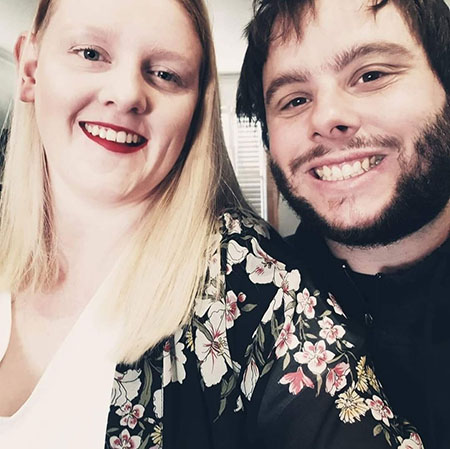
My name is Andrew. In a few words, I’m a cricket and footy fan, a gamer, and a homebody at heart. I work as a laser cutting technician. I’m from the northern suburbs of Melbourne, where I live with my 13-year-old son, my wife of three years Hailey (we’ve been together for eleven), and a daughter on the way. Life in my house is exciting, loud, loving, and just a bit chaotic most of the time, but I wouldn’t have it any other way.
Hailey had her stroke as a kid, and I met her in her twenties, so I missed that part of her life. To be honest, I don’t really “see” her stroke; she’s my wife, and that’s how I see her. There are a few things I’m mindful of and accept, but we’re a very neuro-spicy household, and that’s simply how we have always worked together. It’s just our normal. Every family has its quirks; ours just comes with a few extra considerations.
In the early days, I’ll admit I sometimes thought things like fatigue or emotional regulation were a bit of an overreaction when she explained them to me. But I learned pretty quickly that fatigue hits her much harder than I ever expected, and there isn’t really anything I can do to “fix” it. The main way I can support her is by being patient, understanding, and not minimising how real it is.
It’s a lot easier for her to reach that point of exhaustion, and I always try to keep that in mind. Sometimes there’s no obvious trigger or clear reason why it hits so badly; it just does, and you have to roll with the punches. I’ve found that accepting that reality is much easier than trying to analyse every detail or look for answers where there might not be any. I also know that she is kind of the expert of her own fatigue triggers and knows how to read the play, so mostly it is just her communicating to me where she is at.
I know it can’t be easy approaching life with the barriers she navigates every day, so it doesn’t surprise me that she needs more time to rest, recover, and emotionally recentre.
Life can get heavy, and when it does, emotions and frustration can take over if you’re not careful. In those moments, it’s easy to lose sight of what the other person is dealing with or forget what really matters.
That’s when I remind myself that relationships are all about give and take. If you want it to work, you have to be willing to sometimes bend a little more than you expected. We do our best to validate each other’s feelings and priorities, even when we don’t fully understand them in the moment. Respect is a huge thing in our relationship, and it’s something we always try to come back to, especially when things feel hard.
Support looks different for us on different days. Hailey is an incredibly independent person and always tries to do everything herself, so a lot of my support looks like stepping in quietly when things start to pile up or offering reassurance when she needs it. Over the years though, the meaning of “support” has changed and evolved.
Over the past eleven years, Hailey and I have grown together, and every step we’ve taken has come with its own complexities because of her stroke and because of the way our household works. We moved out together (which was Hailey’s first time living away from home); she became a parent figure to my son; we got married, and now we’re growing our family again. None of it was easy. It took work, communication, compromise, and a lot of acceptance from both of us. But knowing what we wanted, and working toward the same goals as a team, made it manageable. I’ve learned that during times of transition, when roles shift and expectations change, you need to give each other a bit more grace than usual.
My understanding of partnership has grown right alongside me. Not everything is as clear-cut as I once thought. Hindsight really is a strange thing, but I’ve genuinely enjoyed figuring life out with her. You can’t always be at 100%, and you can’t expect your partner to be either. You just pick up what falls to the wayside and try not to make each other feel bad about it.
Some days she can do everything she planned; other days it just doesn’t happen, whether that’s because of fatigue, forgetting something, or simply because the world feels too heavy that day. I try to approach all of it with the same compassion I’d hope she’d give me if our roles were reversed.
To be honest, I didn’t know much about stroke at all before I met Hailey. Over time, I’ve learned that being with someone who is a stroke survivor takes patience, flexibility, and a real willingness to listen and learn. I’ve also learned that no two strokes are the same, and what works for us won’t necessarily work for others. That’s why I think staying open, communicating honestly, and being willing to have uncomfortable conversations really matters.
We’ve both learned that it’s more than okay to ask the stupid or embarrassing questions; they usually end up being the things we laugh about later. And that ability to laugh together, on the good days and the bad, is something I value deeply. Life doesn’t always run smoothly, but having someone beside you, who you can face it with and sometimes laugh your way through it, makes all the difference.