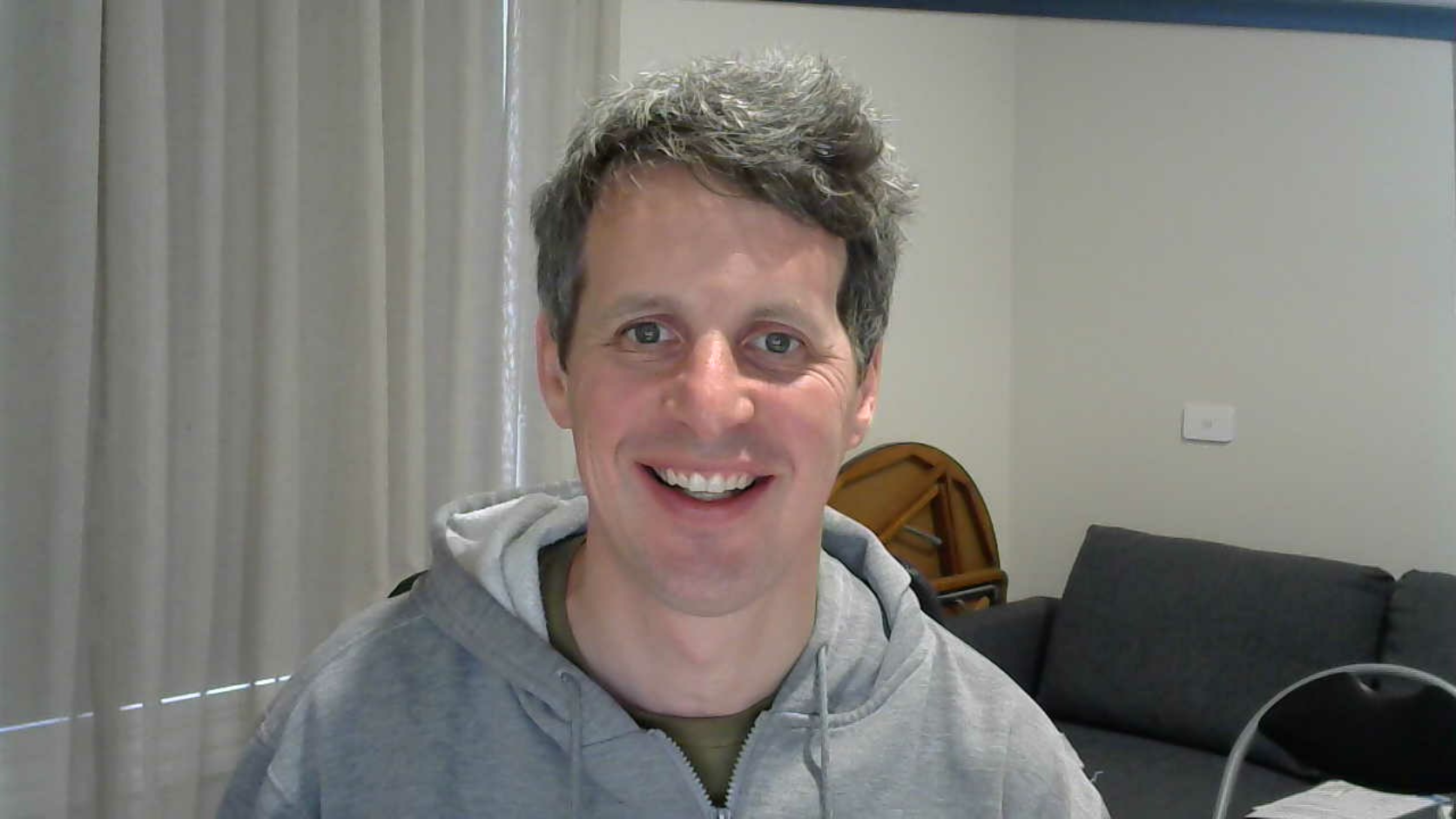
My name is Lachie, and I am a 39-year-old accountant who unfortunately suffered a traumatic brain injury followed by a stroke back in October 2011.
I was doing very well back in 2011 and was performing strongly for one of the Big 4 accounting firms. Then everything changed when I fell from the second story of a building.
I was taken to the Alfred Hospital where they saved my life in the ICU, having to drain fluids from my brain and run a gastrostomy tube into my stomach to keep the food intake up.
I then suffered a stroke whilst in the ICU, which has resulted in me losing vision of my left side and being legally blind.
The stroke has also caused severe muscle contractions which I am still impacted by today.
For the first several years following my accident, my left elbow would remain raised, causing people to nickname it the clothes hanger. This would of course cause embarrassment when out in public and result in my knocking into people in a crowded environment.
This resulted in quite severe self-criticism and a lot of negativity, and I had to fight my way through a lot of self-doubt.
The financial stress of mounting medical bills was severe before the NDIS became operational.
Particularly in the first several years, I required multiple physio and occupational therapist treatments every week. Although I had private health insurance, the limits were hit quite early in the process.
Even now, over 14 years after the accident, I still require a weekly deep tissue massage and days out with a support worker. Without the NDIS, this would not be possible.
I have been able to rejoin the external workforce, spending two years working for the state government in TAFE finance. I recently started a new role with the ATO, and none of this would be possible without the treatments the NDIS has funded for me.
Of course, there are still barriers, like the fact that I require more time to learn and become competent at different processes and outcomes in the workplace.
Certain staff members are less understanding or patient, which can lead to hostility in the workplace.
But still, one step at a time, I wouldn't be here today without the support of the NDIS.
Most of us had no knowledge of the functions of the NDIS before it suddenly became central to our lives.
But now I know, the NDIS is there to support you in getting back into the workplace and maintaining independence.
Typically, you meet once a year, perhaps every 2 years, with a representative from the NDIS to discuss your requirements and what is included in the plan.
Sadly though, the workers have no knowledge of what is typically required after a brain injury.
They therefore choose to cut and dismiss many of the chosen treatments despite their effectiveness and proven results.
It is also rare to have the same worker from your previous year's review for continuity.
This is where a good NDIS Coordinator of Support can be your greatest asset.
I have been very fortunate to have a lady that was involved in the initial Barwon rollout of the NDIS.
As a result, she knows the system inside-out and was able to correct the NDIS representative on multiple occasions.
It is somebody in your corner who knows the laws and regulations to ensure that you are getting the best outcome and ability to move forward in life.
Going back a few years ago, I distinctly remember the NDIS representative proclaiming that treatments A, B and C would no longer be claimable on the NDIS.
My coordinator advocated for me, then recited the exact text from the law, and informed this worker that there would be consequences if they did not submit the NDIS plan we had put forth.
That is an extreme example, but it is reflective of the fight you must have to secure what you need.
My plan was submitted without change.
I cannot recommend any particular NDIS Support Coordinators to you, but make sure they are willing to learn about you and what you are striving to achieve in the future. They can be your biggest asset in getting the NDIS to work effectively for you.
If you are not happy or feel as if the advocate is just going through the motions, then change!
Here is a website describing a NDIS advocate (Support coordinator):
What is a support coordinator | NDIS
Stroke Foundation NDIS Resources:
Stroke recovery and support
Navigating the NDIS