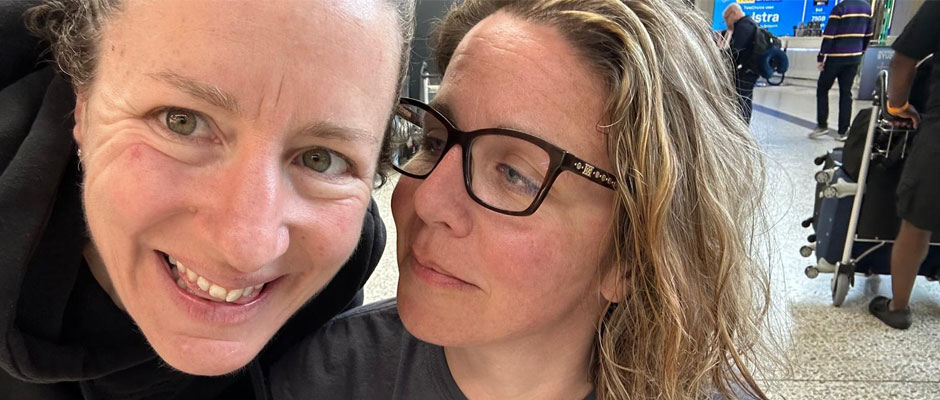
"A life recalibrated".
Handling grief and loss, accepting support
Hi, my name is Lou. I’m a young stroke survivor of 3 years, and I’ve lived here in Victoria for the past 10 years. Before I moved here, I had lived in London for about ten years (I’m originally from the UK) a full decade of becoming me in my twenties and a year of my thirties unfolded there in London: many strong friendships were forged over several pints, late buses home, love, heartbreak, and reinvention. London shaped me. I felt strong there. Established. At home.
We had only just landed in London that very morning. On tenth December 2022, right off a long-haul flight from Melbourne and straight out of Heathrow onto the Piccadilly line to Finsbury Park tube station, we were greeted by our dear friend, Gaby. Weary-eyed and wired all at the same time in that strange way only jet lag can produce. The winter morning light felt sharp and so familiar to me as we headed out, shivering from head to toe, for a walk through Finsbury Park Nat, my partner; Gaby; Ellis, Gaby’s dog; and I trying to shake the travel from our bodies. It feels kind of symbolic in hindsight: walking off the distance and arriving properly.
I was buzzing. It was my belated 40th birthday celebration weekend with my London family in my city. I remember thinking how lucky I was.
Back at Gaby’s kitchen, each stuffing our faces with a bacon butty, the house warmed quickly with anticipation of the party that was to be that night. Our coats are over chairs, chatter, and plans. Nat and I went for a token jet lag sleep. We woke 2 hours later and started to get ready. I was dressed for the party properly dressed. Not ‘trackies from a flight’ dressed. Celebratory. Nice shirt on, hair styled, ready, ready. Nat popped out with her brother, Dan, and his fiancée, Ellie, to grab some drinks for the evening. And then something shifted.
Pins and needles in my left leg with a strange fizzing. At first it felt like one of those fleeting travel sensations dehydration, tiredness, altitude residue. We’d only landed hours before. It was easy to rationalise.
But my body was already in crisis. Gaby saw it in my face before I understood it myself. Something wasn’t right. She ran into the street in the hope that Nat was there.
The moment Nat saw me, she knew (an ED nurse through and through), confirmed by the second opinion from Ellie (a GP). No hesitation. She called 999. They didn’t answer.
In the city I had called home for a decade, on the first night of my holiday and my birthday weekend, I was deteriorating quickly (dying), so they acted. They all carried me to the car; barely conscious, Gaby drove us at speed to Whittington Hospital through streets I know by heart but will never experience the same way again.
A haemorrhagic stroke caused by a ruptured AVM, which I never knew I had, took me from party-ready in a friend’s kitchen to emergency neurosurgery in hours.
To save my life, the surgeons performed a decompressive craniectomy, removing part of my skull to allow my brain to swell safely. One third of it. Survival required subtraction.
Recovery unfolded slowly across seven months and three hospitals, with a ruptured aneurysm and a severe staph infection here and there that delayed my cranioplasty and required me to wear a helmet for the whole time I was in the hospital, my rehabilitation measured in small, stubborn gains. Neurological fatigue that felt like someone dimming the lights mid-thought. The woman who had stepped off a plane on that fateful morning, smiling and celebrating being on home soil, felt both close and impossibly distant.
Eventually, we got clearance from my neurosurgeon to fly home to Australia.
We weren’t just ‘going home.' We were leaving the therapists and nurses that helped me learn how to speak, laugh, and walk again; our family and friends that had metaphorically wrapped us in cotton wool in London. We were returning as altered versions of ourselves. I was still missing one third of my skull the custom-made replacement plate for my skull was traveling home in our hand luggage.
It remains one of the strangest images of my life: somewhere above the clouds, between noise-cancelling headphones and travel pillows, was a titanium model of a piece of my head. We flew business class because of medical necessity (every cloud, hey). There is something darkly comic about sipping champagne at 35,000 feet while your skull plate sits in the overhead locker.
Stroke changes how you experience the world. The flight was long. Sound, pressure, fatigue everything hit very differently. What used to be background noise now demanded my energy. What once felt effortless required careful pacing.
Landing in Australia wasn’t just geographical. It was existential. Home looked different because I was different.
The next adjustment was the one that scraped at my old identity the most: accepting support workers into our home. I struggled with the dated language of "carers," as some people like to say; it felt like a word that belonged to someone else’s story. I had been fiercely independent. Capable. Active. Professional. Self-sufficient.
Letting people help me felt like admitting permanence.
And then there was the harder layer learning not just to accept support, but to shape it.
It has been hard to say, “Don’t do that in that way, please.”
Hard to correct. Hard to direct. Hard to assert preferences in my own home when my body had already betrayed me once.
For a long time, Nat was my voice. I needed her to advocate for me to translate my fatigued speech into something that made sense, to catch what I couldn’t articulate, and to protect my energy. I am endlessly grateful for that. But somewhere in the last three years, I have relearned how to use my own voice again with confidence.
My voice now, more than ever, is my shield in this journey.
There is no returning 100% to who I was that morning in Finsbury Park.
There is only integration.
There has been grief for my old stamina, for my left dominant arm, for cognitive sharpness on demand, for health being guaranteed, and, confusingly, for a young life not lost. But there has also been rebuilding. Accepting support has become less about surrender and more about sustainability. Less about weakness and more about designing a life that works now.
This is not a story with a neat recovery arc. It is a lifelong recalibration.
I am constantly learning my limits without letting them define me. Learning that strength can look like rest. Learning that independence can coexist with support. Learning to live this life not the one I expected when I stepped off that plane in London, all pumped for a party, but the one I have. Learning to love the little town we now live in. We chose to buy here as our regional ‘every other weekend getaway’ from the hustle and bustle of the city. Not perfectly accessible for me, but we’re getting there as a community collective, bit by bit. Perfectly surrounded by love from the small community though. There are barriers in regional Victoria for trained neurotherapists, in my case, neuro-arm therapists. NDIS has a lot to learn about stroke recovery participants in regional or remote areas. Travel costs not recognized. Needing to travel to cities is the only way to get specialised therapy to keep recovering through your surprise disability. Having physical therapy is the best way for a person to stop the stroke's winning.
My London fortieth began with flight trackies and jet lag. It continued under fluorescent lights and an induced coma.
And it carries on now, in a different hemisphere, with a different understanding of what survival means.
I am still here.
And I am still learning how to live it.
I often say to people, “Right time, right place, right people" Nat, Gaby, Ellie, and Dan. If it was inevitable and it was going to happen one day, I’m kind of glad I got this version of it, even if it’s bittersweet for me.
Lou Feeley